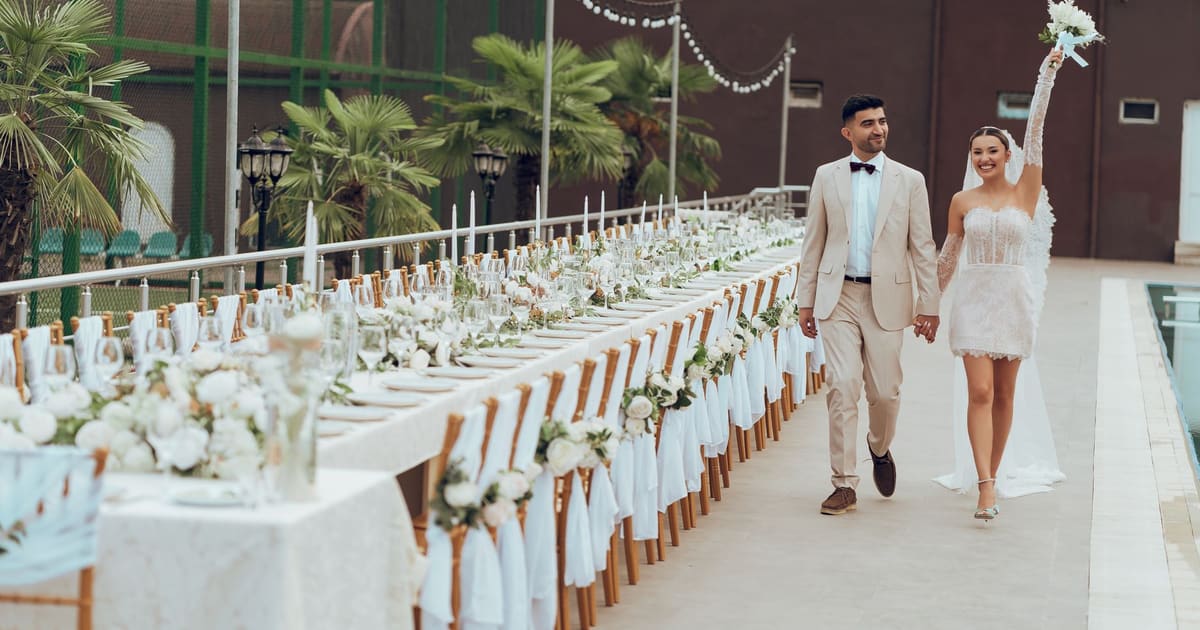
Outdoor weddings offer natural scenery and a relaxed atmosphere; indoor venues provide climate control, built-in infrastructure, and a predictable backup from the start. The right choice depends on your region, season, budget, and risk tolerance -- not on which photos look better on social media. This guide lays out the real costs and honest trade-offs so you can decide before you book.
What You Are Actually Choosing Between
When couples say "outdoor wedding," they usually mean one of three things: a garden ceremony at a dedicated venue (with some indoor reception space nearby), a fully outdoor event in a park or private property, or a hybrid where the ceremony is outside and the reception moves indoors. Each carries a different risk and cost profile.
Indoor weddings include hotel ballrooms, restaurant private rooms, museum halls, converted warehouses, and dedicated event spaces. The defining feature is that weather is no longer a variable you are managing.
Understanding which category you are actually in matters before you compare costs. A garden ceremony with an indoor reception fallback is meaningfully different from an all-outdoor tent reception with no covered alternative.
Side-by-Side Comparison
| Factor | Outdoor | Indoor |
|---|---|---|
| Weather risk | High -- rain, wind, heat, cold | None |
| Rental add-ons | Tent ($1,500-$10,000), generator ($500-$1,500), portable restrooms ($150-$400/unit), lighting ($800-$3,000) | Typically included in venue fee |
| Backup plan required | Yes -- non-negotiable | Built-in |
| Catering flexibility | Usually open -- bring your own | Often restricted to preferred list |
| Guest comfort in summer | Variable -- fans and misters add cost | Climate-controlled |
| Ambiance control | Dependent on time of day and season | Fully controllable |
| Photography lighting | Natural light (best morning, golden hour) | Requires coordination with venue lighting |
| Noise ordinances | Common -- check local rules | Rarely an issue indoors |
| Permit requirements | Often yes (parks, public spaces) | Rarely required |
| Average venue fee | $2,500-$8,000 (site only) | $3,000-$12,000 (bundled) |
Venue fees sourced from WeddingWire Newlywed Report regional averages; ranges reflect US variation by market.
The Real Cost of Going Outdoor
The biggest financial surprise for couples who book outdoor venues is the gap between the venue rental fee and the total event cost. The site fee is often the smallest line item.
Here is what you are likely to add:
Tent. If there is any chance of rain -- or strong afternoon sun -- you need a tent. The Knot Real Weddings Study reports tent rentals typically run $1,500 to $10,000, depending on guest count and style. A 40x80 pole tent for 150 guests runs around $2,500 to $4,500 in most markets. Clear-span structures with sidewalls and climate control can push $8,000 to $12,000 for the same headcount.
Generator. Most open-air venues lack sufficient power for catering, DJ or band, lighting, and climate systems simultaneously. Generator rentals run $500 to $1,500 per day, according to national event rental averages compiled by WeddingWire.
Portable restrooms. Luxury restroom trailers (the kind with running water, mirrors, and climate control) run $150 to $400 per unit, with most events needing two to four units for 100 to 200 guests. Standard portable toilets are cheaper but rarely appropriate for a wedding.
Lighting. String lights, uplighting, and lanterns that make outdoor photos look the way you picture them cost $800 to $3,000 for a typical installation, per WeddingWire Newlywed Report data.
Flooring. If your outdoor surface is grass or gravel, you may need dance floor panels or interlocking tiles to prevent heels from sinking. Expect $600 to $2,000 depending on square footage.
The following illustration shows how outdoor hidden costs stack relative to the base venue fee.
Tip
Get rental quotes in writing before you sign the venue contract. The venue coordinator may give you a verbal estimate; the actual rental company will give you a real number. The gap is often $2,000 to $4,000. You need both numbers to evaluate the true cost of the venue.
Outdoor Wedding Pros
The setting does the work. A vineyard at dusk, a cliffside with ocean views, a historic garden -- these environments create visual impact that no ballroom decor budget can fully replicate. If the location matters to you and your guests, outdoor can justify the added cost.
More catering flexibility. Most outdoor venues operate as "raw space" or "site only," meaning you hire your own caterer. That freedom can save money if you source an independent caterer rather than a venue-captive kitchen with premium pricing.
Fewer guest-count constraints. Many indoor venues have hard maximums tied to fire code. An outdoor tent setup can sometimes scale to accommodate a larger list with fewer venue-change penalties.
Natural light for photography. If you are prioritizing photos, soft morning light or golden-hour evening light outdoors is genuinely difficult to replicate artificially. Your photographer will likely tell you the same.
Outdoor Wedding Cons
Weather is a real threat, not a hypothetical one. According to WeddingWire data, roughly one in five outdoor weddings experiences some weather disruption. Rain is the most common, but heat exhaustion (in summer ceremonies starting after noon), wind knocking over centerpieces, and unexpected cold snaps in May or September are all documented problems.
Logistics multiply quickly. Every vendor -- caterer, florist, DJ, lighting company -- has to travel to and set up in a location that may lack loading docks, prep kitchens, electrical access, and easy parking. Setup time increases, which means vendor costs increase.
Noise ordinances are common. Most counties and municipalities have sound cutoff rules, typically 10 pm. An outdoor venue with no interior fallback means the band stops playing when the ordinance says so -- not when you want to stop dancing.
Permits add friction. Public parks and some private outdoor spaces require event permits, liability insurance certificates, and advance applications that can take four to six weeks. Missing the window means losing the date.
Indoor Wedding Pros
Predictability. You know the room. You know the lighting. You know the temperature. Your guests know where to park. Your vendors know how to access the kitchen. Predictability is underrated.
Built-in infrastructure. Commercial kitchens, adequate restrooms, existing electrical capacity, HVAC, and tables and chairs already on-site are not amenities -- they are cost savings bundled into the venue fee. The WeddingWire Newlywed Report notes that couples who move to indoor venues after initially planning outdoor events consistently report lower final costs despite higher headline venue fees.
Flexible timing. Your event can run as late as the venue allows (often midnight or 1 am) without a noise ordinance cutting off the music.
Acoustic control. Indoor spaces designed for events handle sound better than tents or open air, which matters for speeches, ceremony audio, and band performance quality.
Indoor Wedding Cons
Less flexibility on vendors. Full-service hotels and traditional banquet halls frequently require you to use their in-house caterer or select from a preferred vendor list. The per-person markup on captive catering can run $15 to $40 above independent caterer pricing, according to The Knot Real Weddings Study vendor pricing data.
The room has to work harder. An empty ballroom is just a room. Transforming it into something that looks like you rather than a corporate event requires florals, draping, lighting design, and decor. Couples who care deeply about personalized aesthetics often find indoor transformation costs add up faster than expected.
Guest-count caps. Fire code limits are strict. If your list grows after you book, indoor venues often cannot flex without a venue change.
The setting is not the story. If you want your photos to show a specific landscape, a barn, or a skyline, a standard hotel ballroom cannot provide that. The venue is the background, not the scene.
Weather and Contingency Planning
Warning
An outdoor wedding with no backup plan is an incomplete plan. This is not a pessimistic statement -- it is a contractual reality. Most outdoor venues require you to name a contingency option before they will finalize your contract. If a venue does not require this, ask anyway. The cost of moving an outdoor event indoors on 48 hours notice -- renting a last-minute indoor space, rebooking vendors, reprinting directional signage -- typically runs $1,500 to $4,000, according to event coordinator surveys cited in WeddingWire industry reports. That is the minimum disruption scenario. A good contingency plan, negotiated in advance, costs less and causes far less stress.
Contingency options worth exploring before you book:
- The venue itself often has indoor space. Many dedicated outdoor wedding venues (wineries, estates, gardens) have an indoor room for exactly this purpose. Confirm the maximum headcount of that backup room -- if it fits 60 and you have 120 guests, it is not a real backup.
- A nearby hotel ballroom on hold. Some planners negotiate a courtesy hold on a nearby hotel for the weekend, paying a small deposit to keep the option open.
- A tent with solid sidewalls. If rain is the main concern, a properly staked tent with full sidewalls handles most rain events. Wind is harder to manage; clear-span structures handle it better than pole tents.
The following illustration shows a simplified contingency decision path.
How to Match the Setting to Your Priorities
The couples who end up happiest with their venue decision are the ones who ranked their priorities before touring venues, not after. Here is a straightforward way to think through it.
If you prioritize guest comfort above everything else, indoor wins. Climate control, reliable restrooms, parking, and easy accessibility for older guests or guests with mobility limitations are all dramatically easier to guarantee indoors.
If the visual setting is the priority and you have flexibility on budget, outdoor with a solid contingency plan is worth the added cost. Budget an extra $5,000 to $10,000 above the site fee to account for the rental stack.
If you are working with a tighter overall budget, do not assume outdoor is cheaper because the site fee is lower. Add up the rental stack first. In many markets, a well-negotiated hotel ballroom with in-house catering costs less total than a scenic outdoor site once infrastructure is factored in.
If your guest list is over 150 people, outdoor logistics become significantly more complex. Larger guest counts mean more generator capacity, more restroom units, a larger tent, and longer vendor setup times. The cost curve is not linear.
Key takeaway
The outdoor-versus-indoor decision is primarily a budget and risk-tolerance question, not an aesthetics question. Choose outdoor because the setting genuinely matters to you and you have the budget to do it properly -- not because it seems like it will cost less. Run the full rental stack estimate before signing anything.
Questions to Ask Before You Book Either Type
Before you commit to a venue, get clear answers to these:
For outdoor venues:
- What is the contingency plan, and what does it hold?
- Are tent, generator, and restroom vendors sourced through you or do I contract them independently?
- What is the noise ordinance cutoff for this location?
- Is there a ceremony-to-reception gap when guests must wait somewhere?
- What are the permit requirements and who is responsible for filing?
For indoor venues:
- Is catering exclusive, or can I bring my own vendor?
- What is the lighting setup and can we bring in additional fixtures?
- What are the capacity limits and are there minimums for food and beverage?
- What is the overtime fee if we run past the contracted end time?
You will find a full list of venue questions -- for both venue types -- in Questions to Ask Your Wedding Venue.
What Planners Actually See
Wedding planners consistently report that couples underestimate outdoor rental costs and overestimate the difficulty of making an indoor venue feel personal. Both are correctable with good planning.
The couples who regret outdoor weddings almost always cite one of two things: weather disruption with no real backup, or sticker shock when the final invoice included every rental item they did not anticipate. The couples who regret indoor venues usually say the room felt generic and they ran out of decor budget trying to fix it.
Both regrets are preventable. The outdoor couple needed a more complete budget upfront. The indoor couple needed to visit the venue dressed for an event, not an empty-room walkthrough, and to review floral and lighting quotes before signing.
For a detailed breakdown of how venue fees vary by state and market, see Wedding Venue Costs: What to Expect in 2026. If you are specifically comparing barn and ballroom options within the indoor category, Barn vs. Ballroom: Which Wedding Venue Is Right for You? covers the style, infrastructure, and cost differences between those two formats.
For the couples choosing primarily on budget timing, Cheapest Months to Get Married shows how season affects both venue availability and pricing -- and why the outdoor-friendly months are also the most competitive to book.
Frequently asked questions
How much more does an outdoor wedding cost than an indoor one?
Outdoor weddings typically cost $3,000 to $12,000 more than indoor venues once you add tent rental, generator, portable restrooms, and lighting. The Knot Real Weddings Study reports average tent rentals alone run $1,500 to $10,000 depending on size. Indoor venues bundle most of those utilities into the base rate.
What is the biggest risk of an outdoor wedding?
Weather is the primary risk -- not just rain, but heat, wind, and humidity. A backup plan is not optional. Most outdoor venues require you to identify and book a contingency space before the contract is signed. Skipping this step is the single most common outdoor wedding regret planners report.
What is the best time of year for an outdoor wedding in the US?
Late May, early June, September, and October consistently rank as the most reliable months for outdoor ceremonies across most US regions, according to WeddingWire Newlywed Reports. Humidity spikes in July and August in the South and Midwest. Spring weddings east of the Rockies carry higher rain probability.
Do indoor venues restrict your catering choices?
Most full-service indoor venues have preferred or exclusive caterer lists, which can add $15 to $40 per person compared to sourcing independently. Raw spaces and converted warehouses typically give you more freedom. Always confirm catering restrictions before signing -- it affects your total food and beverage budget significantly.
Can you have a garden wedding on a tight budget?
Yes, with trade-offs. A private garden or park permit can cost $200 to $1,500 in rental fees, well below traditional venue rates. But you absorb every infrastructure cost: chairs, tables, linens, restrooms, generator, lighting, catering setup. Factor those in before assuming it saves money.