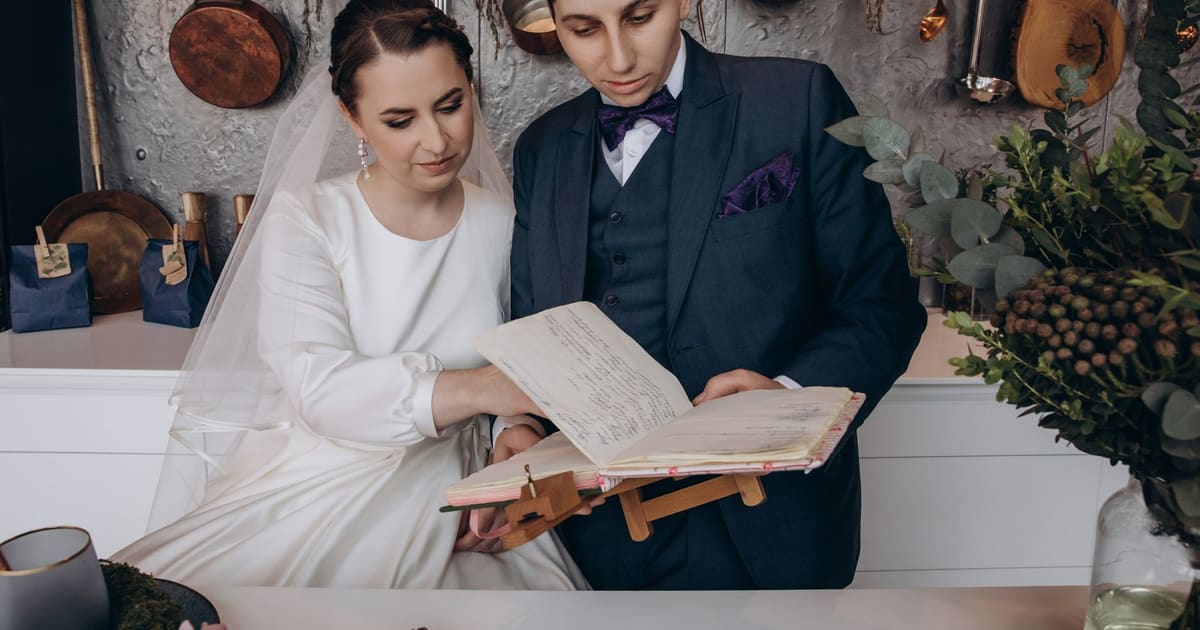
A well-chosen ceremony reading does one thing: it says something true about the relationship that the vows alone do not cover. A poorly chosen one is two minutes of guests staring at the program waiting for it to end. Knowing the difference before you choose -- or before you say yes to whatever your aunt already has printed out -- is the entire point of this guide.
What makes a good wedding ceremony reading?
The test is simple: does the reading say something specific and true about love, commitment, or this particular relationship -- and can it be delivered aloud by someone who may be nervous?
Three things that make a reading work:
It says something the couple actually believes. Generic sentiments about love being patient and kind are not wrong, but they do not add anything specific to your ceremony. The best readings are ones that both partners read and say "yes, that is exactly it." If the reading feels chosen because it is available, rather than because it resonates, pick something else.
It works when read aloud by a non-professional. Long, winding sentences that work on the page fall apart when read aloud by someone who is nervous or holding back tears. Short sentences, clear rhythm, and punctuation that creates natural pause points are all in your favor. Read the passage aloud yourself before you assign it. If you stumble on it, your reader probably will too.
It is short enough to hold the room. Two minutes is the upper limit for most ceremonies. A reading that hits 3 to 4 minutes is working against you -- guests start to drift, the pacing of the ceremony stretches, and the reader knows they are going long, which affects their delivery.
How many readings is standard at a wedding ceremony?
Most US ceremonies include one or two readings. Religious ceremonies -- Catholic Masses, Jewish ceremonies, some Protestant traditions -- often have two or more structured reading slots built into the liturgy. Secular ceremonies can include as many as the couple wants, but more than two is uncommon.
One reading is clean and focused. Two readings are common and work well when the tones are varied. If you want three, consider whether you have three genuinely distinct, well-chosen passages -- or whether one of them is filler.
The ceremony structure matters too. A ceremony that runs 25 minutes with one reading, a unity ritual, personal vows, and two sets of ring vows is already full. Adding a second or third reading extends a ceremony that guests may already be sitting through outdoors in the sun.
For the overall ceremony and reception flow, see Wedding Day Timeline Guide.
Tip
Send your reader the text at least 4 weeks before the wedding, not the week before. They need time to practice and to come back to you with questions -- "should I pause here?" or "is this word pronounced [X]?" -- without the pressure of the rehearsal being two days away.
Non-religious readings: poetry, literature, and original pieces
The non-religious reading category is wide, which is useful if you are looking for something specific. Below are the most consistently effective options based on how well they work when read aloud in a real ceremony context.
Short prose excerpts tend to work best for nervous readers. Clean, declarative sentences are easier to deliver under pressure than complex syntax. Commonly used prose sources include:
- Excerpts from Louis de Bernieres' Captain Corelli's Mandolin ("Love is not breathlessness...")
- Kahlil Gibran's The Prophet (particularly the passage on marriage from Chapter XI)
- Antoine de Saint-Exupery's The Little Prince
- Rainer Maria Rilke's Letters to a Young Poet (particularly Letter 7, on love)
Poetry rewards the right reader -- someone who is comfortable with pacing, who will not rush through the line breaks. Poetry that falls flat is usually poetry read too fast by someone who is uncomfortable with the silence. Neruda's Sonnet XVII ("I do not love you as if you were salt-rose...") is the most commonly cited wedding poem in US ceremonies for good reason -- it is specific, not cliched, and it closes memorably. Billy Collins' "The Art of Drowning" and Mary Oliver's "When Death Comes" appear less frequently but work well for couples who want something less traditional.
Original pieces written by the reader are high-risk, high-reward. They can be deeply moving. They can also run long, include inside jokes that land with 12 people and confuse the other 150, and fall apart emotionally if the reader cannot hold it together. If someone offers to write an original reading, ask to review it before the ceremony, and give honest feedback. Length is the most common issue.
Religious and spiritual readings: choosing from tradition
If you are working with a religious officiant or holding your ceremony in a religious venue, your reading choices may be more constrained by tradition. Most religious ceremonies have approved reading selections, and your officiant will either require or strongly recommend reading from that list.
For Catholic ceremonies, readings are typically drawn from the Old Testament, the New Testament, and the Psalms, with specific guidance from the Lectionary. Your priest will walk you through options. The most commonly chosen at Catholic weddings are 1 Corinthians 13 ("Love is patient, love is kind..."), the Song of Songs, and John 15:12-16.
For Jewish ceremonies, readings may come from the Song of Songs or from contemporary Jewish literature, depending on denomination and rabbi. Reform ceremonies often allow more flexibility for secular or personal readings alongside traditional elements.
For interfaith and civil ceremonies performed by an officiant with no denominational affiliation, you typically have full flexibility. This is where the secular options above apply.
Talk with your officiant early about what is and is not permitted at your specific ceremony. Do not assume freedom you have not confirmed. See Wedding Officiant Cost: What to Budget in 2026 for more on how officiant type affects ceremony structure.
How to choose who does the reading
The question is not who is the most confident speaker. It is who has a genuine relationship with you, who can hold themselves together under the emotional pressure of the day, and who will do the preparation.
A person who is deeply meaningful to you but anxious about speaking can be a better reader than a polished speaker who barely knows you. Anxiety usually resolves with preparation. Disconnection from the moment does not.
Factors to consider:
- Would this person's presence at the lectern mean something to the guests who know you?
- Are they willing to practice -- not just once, but multiple times aloud?
- Can they handle being emotional without losing the thread of the reading?
- Do they have any reason to use the reading slot as an opportunity to say other things?
That last point matters more than it might seem. The reading has a defined scope: deliver the text. If the person you are considering has a pattern of expanding any given moment into a larger statement, give them another role in the wedding.
Warning
Do not assign a reading to someone at the last minute or as a consolation for not being in the wedding party. The person doing the reading needs time, preparation, and genuine investment in doing it well. Asking someone three weeks before the wedding -- or the day of -- almost always results in a reading that does not land the way you wanted.
Coaching your reader on pacing and delivery
Most reading problems are pacing problems. Nervous readers go too fast. Emotional readers go too fast to hide the emotion. Give your reader three specific instructions:
- Pause for two full beats at every period. Not one beat -- two. It will feel slow to the reader and sound exactly right to the audience.
- Look up at the couple at least once during the reading. Not at the guests, not at the officiant -- at the two people the reading is for. This shifts the feeling of the entire moment.
- If you feel yourself starting to cry, stop and breathe before the next sentence. Not through -- before. One full breath. Then continue.
If the ceremony includes a microphone at the lectern, ask your venue or sound technician whether there is a monitor speaker so the reader can hear themselves. Readers who cannot hear their own voice naturally rush.
For the checklist of when to lock in your readings relative to other planning tasks, see Wedding Planning Checklist: Month-by-Month Timeline.
Readings that work under two minutes
If you want to be certain your reading fits in the window, here are length benchmarks:
| Word Count | Approximate Read Time (at measured pace) |
|---|---|
| 150 words | 60 - 75 seconds |
| 250 words | 90 seconds - 2 minutes |
| 350 words | 2 - 2.5 minutes |
| 500 words | 3 - 3.5 minutes |
The 250- to 350-word range is the practical sweet spot: long enough to land, short enough to hold the room without strain.
If you have a reading you love that runs to 600 words, consider whether there is a natural cut point -- a section that stands on its own without requiring the rest. Many literary readings excerpt well if you find the right 4 to 5 paragraph arc.
Key takeaway
A good ceremony reading is short (250 to 350 words), says something specific and true, and is given to someone who will practice. Assign the reader at least 4 weeks out, send the text immediately, and ask them to read it aloud three times before the rehearsal. Pacing is the most common failure mode -- coach explicitly for it.
Frequently asked questions
How long should a wedding reading be?
Most ceremony readings run 90 seconds to 3 minutes when read aloud at a measured pace. That translates to roughly 250 to 500 words of prose, or 10 to 20 lines of poetry. Under 90 seconds feels like a line item rather than a moment. Over 4 minutes risks losing the room. The sweet spot is something your reader can deliver in 2 minutes without rushing.
Can you have more than one reading at a wedding?
Yes. Two readings are common in religious ceremonies and increasingly common in secular ones. Three or more start to stretch the ceremony unless the overall structure is specifically built around them. If you have two readings, vary the tone -- pair something earnest with something lighter, or pair a poem with a prose excerpt. Two readings with identical emotional registers flatten each other.
What is a good secular reading for a wedding ceremony?
Commonly used secular readings include Captain Corelli's Mandolin (Louis de Bernieres), The Art of Marriage (attributed variously but frequently used), excerpts from The Velveteen Rabbit, passages from Pablo Neruda's love poems, and selected prose from Kahlil Gibran's The Prophet. The quality of the reading matters less than whether it actually sounds like something the couple would say. Generic 'love is patient' passages work; overused ones can feel like filler.
Should the reader practice the reading before the ceremony?
Yes, and they should practice aloud -- not just silently. A passage that looks smooth on paper can have an unexpected word that catches the reader mid-breath. Ask them to practice at least three times and time themselves. The ceremony rehearsal is the right moment to do a full run-through with the microphone if there is one.
Can a reading be a song lyric or a movie quote?
Yes, provided it works as spoken prose rather than as song. Song lyrics that rhyme heavily or have a strong meter can sound strange when spoken without music. Prose-forward lyrics -- ones where the words stand on their own -- translate better. Movie quotes work if they carry genuine meaning for the couple and are not so recognizable that the audience is mentally filling in the rest of the scene instead of listening.
Who typically does a reading at a wedding ceremony?
A sibling, close friend, or parent who is comfortable speaking in front of a group and who has a relationship with one or both partners. The reader should be someone whose presence at the lectern means something -- not just the most confident public speaker available. If the most natural choice is shy about speaking, a brief conversation about practicing ahead of time often resolves the hesitation.